

 14/03/2026
14/03/2026
Stress Test for Dubai: What Could Happen to The UAE Real Estate Market Amid Tensions in The Middle East — Two Scenarios


CEO of Inside Realty
CEO of Inside Realty

The escalation of tensions in the Middle East in early March triggered the expected reaction in financial markets. Regional equities declined, international banks began reassessing operational risks, and investors started discussing the possibility of capital outflows.
Against this backdrop, social media has seen a wave of predictions about a potential "collapse" of Dubai’s real estate market. However, macroeconomic indicators and transaction data so far suggest a far more nuanced — and much less dramatic — picture.
Inside has prepared an analytical overview of what may lie ahead for Dubai’s real estate market.
Dubai’s Real Estate Market Enters The Crisis at a Historical Peak
The first factor analysts look at is the point in the cycle at which the market encountered the geopolitical shock.
2025 was a record year for Dubai’s real estate market. According to the Dubai Land Department, the total transaction volume exceeded AED 682 billion ($186 billion) — 30.6% higher than the previous year.
Growth has continued into 2026. In February alone, 16,959 transactions were registered with a total value of AED 60.6 billion ($16.5 billion) — 18% higher in value compared to February 2025.
In other words, the market entered the current period of uncertainty not from a downturn, but after several years of rapid growth.
The market structure also highlights strong investor activity:


Ready Properties
38% Deals
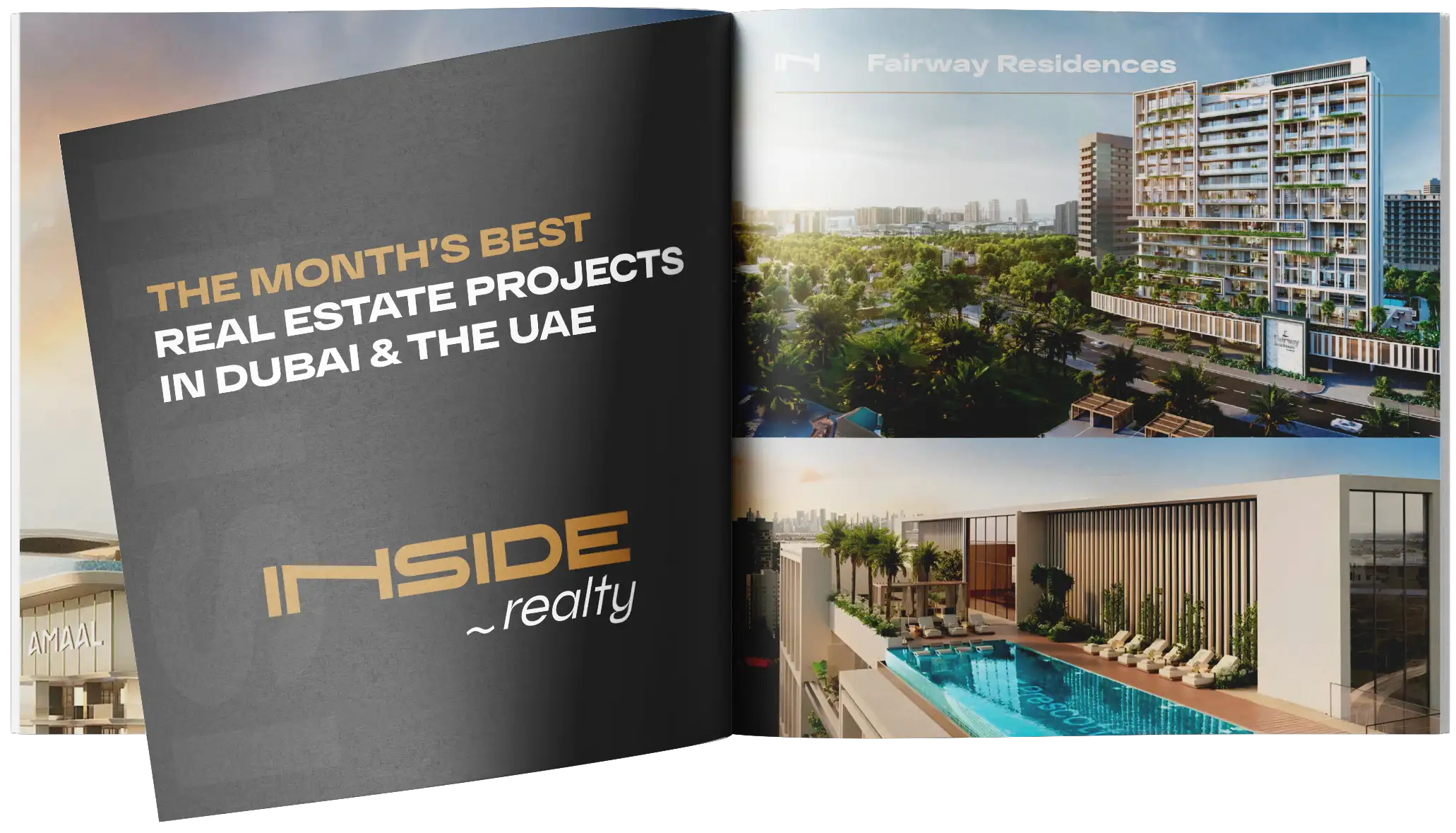
Best Properties of The Month
in The UAE Selected by Experts

Explore the new real estate projects
that we recommend in October 2026
The Month's Best
Properties in UAE
Selected by Experts
How Financial Markets Are Reacting — and Why the Media is Reporting a “20% Crash” in Dubai Real Estate
Unlike real estate, stock markets react to crises almost immediately.
Following news of the regional conflict, shares of several banks and companies with exposure to the region began to decline. For example, HSBC and Standard Chartered shares have fallen 14% and 11.4% respectively since the escalation began.
For the property market, this matters for one key reason: stock markets often act as an early indicator of investor sentiment.
However, even under these conditions, investment interest in Dubai real estate remains strong. Recently, one of the largest residential deals in the city’s history was recorded — an apartment sold for AED 422 million. Transactions of this scale are typically completed by ultra-high-net-worth individuals and family offices, reflecting long-term confidence in the market.
Let’s look at the most interesting indicator — the index of UAE construction companies. What has happened there? Over the past few days, the index has fallen 18%, more than some neighboring markets. Notably, the decline was artificially limited, as individual stocks are restricted from dropping more than 5% per day.
What does this index represent? It reflects the share prices of Dubai’s listed construction companies. Today it has returned to the levels of December 2025. This index tends to react first because it often includes less experienced retail investors, who may respond emotionally to uncertainty — as many are doing now — and begin selling shares. This is why prices have dropped sharply over the past few days.
If we look at more sophisticated instruments used by professional investors, such as the corporate bonds of developers like Aldar, Emaar, and Binghatti, we also saw an initial decline of around 3–5% during the first week, depending on the company.
However, part of that decline has already been recovered. For example:
- Aldar has gained about 1%
- Emaar remains largely unchanged
- DAMAC has risen by 2.2%

This suggests that because the average maturity of these bonds is 3–5 years, large institutional investors do not expect long-term problems for Dubai’s real estate market or these developers. Overall, the reaction among professional investors remains calm and measured, with the understanding that markets typically recover over time — and there is no sign of panic among major capital players.
Why Dubai Real Estate Reacts More Slowly
Real estate behaves differently from financial assets in terms of reaction speed. Stocks and bonds can be sold in seconds, while property transactions follow a much longer cycle:
- Negotiations
- Due diligence
- Contract signing
- Transaction registration
Because of this, any changes in the real estate market typically appear with a delay of several weeks or even months. This means that the current transaction statistics largely reflect decisions that were made before the crisis began. The effects of the recent escalation are therefore likely to be felt in Dubai’s real estate market within the next 1–3 months.
The UAE Banking System Remains Resilient
To assess what may happen to Dubai’s real estate market, it is essential to look at fundamental economic indicators. One of the key pillars of stability for any property market is the health of the banking system.
According to the UAE Central Bank, as of early March:
- The capital adequacy ratio of banks is around 17%
- The liquidity coverage ratio exceeds 146%,
- The total assets of the banking sector exceed AED 5.4 trillion ($1.47 trillion)
For comparison, international regulators typically require capital adequacy levels of around 10–13%.
This means the UAE banking system has a significant buffer of resilience, even in the face of macroeconomic shocks.
In addition, the quality of bank loan portfolios has improved. The share of non-performing loans has more than halved in recent years — from 6.8% in 2022 to around 3.4% in 2025.
The stability of the banking system is one of the most fundamental elements of a country’s economy. In the UAE, the reliability of the banking sector remains high, meaning the risk of sovereign default is extremely low.
Another indicator used to assess such risks is CDS (Credit Default Swap) — essentially insurance against a country’s default. The higher the CDS level, the higher the market perceives the risk.
What is happening now? Abu Dhabi’s CDS has increased by only 3–5 points. There is a slight rise, but it remains minimal.
For comparison: during the Arab Spring or the COVID period, CDS spreads increased by 80–120 points, during the 2009 financial crisis, they surged by around 600 points, the most severe crisis for the UAE.
Today’s increase is only 5–8 points, indicating that markets do not expect any default risk in the UAE largely because the country maintains substantial financial reserves.
This also reflects the strength of the banking sector. On March 5, the UAE Central Bank confirmed that: capital adequacy stands at 17%, bank liquidity coverage is 146%.
In other words, liquidity exceeds regulatory requirements by 46%. With total sector assets above AED 5.4 trillion, the financial system remains extremely robust.
At this level of financial stability, there are no signs of a systemic crisis. The banking system remains confident and well-capitalized — and there is no indication that anything is about to collapse.
Arsenii Mokov from Inside Realty
The Key Question: Will Dubai Maintain Its Safe Haven Status?
In recent years, Dubai has effectively become a global safe haven for capital. Several factors have supported this position:
- A favorable tax system
- Residency and Golden Visa programs
- A stable banking infrastructure
- Geopolitical neutrality
As long as these fundamentals remain in place — and there are currently no indications that they will change — a large-scale outflow of capital from the country is unlikely.
Two Scenarios for Dubai’s Real Estate Market
The outlook for Dubai’s property market depends on several key factors.
First, whether the UAE remains outside the direct conflict. The Emirati government has taken a clear position — it does not allow its airspace or territory to be used for attacks on Iran. For now, the country is maintaining neutrality as much as possible.
Second, whether critical infrastructure and logistics continue to function smoothly — aviation, banking, and payment systems. The key question is whether these systems will keep operating without disruption. At the moment, they are: stores remain stocked, water supply is stable, banks are operating, money can be withdrawn and transferred, flights continue, exchange offices are open, and the currency remains stable.
Third, whether Dubai retains its reputation as a safe haven for capital. So far, there is no evidence of a large-scale outflow of funds from the UAE. As a result, major funds and wealthy investors are largely taking a wait-and-see approach.
What could happen next? Economists are currently considering two main scenarios.
Rapid
De-Escalation
If tensions ease in the coming months:
- The market may temporarily slow down
- The number of transactions may decline
- More room for negotiation may appear in the secondary market
However, a significant drop in prices is not expected in this scenario. Instead, the market may see a mild correction and a short-term cooling period. Investors may find opportunities to acquire assets at discounts from sellers who reacted prematurely to uncertainty. As tourism returns and business activity normalizes, demand for real estate in Dubai is likely to remain strong.
Prolonged
Geopolitical Instability
Prolonged
Geopolitical Instability
If the conflict continues through the autumn, the consequences could be more significant — and not only for Dubai. International rating agencies have already warned about the possibility of a price correction after several years of strong growth. For example, Fitch has previously suggested that prices could decline by double-digit percentages as housing supply increases.
However, even in this scenario, the discussion is more about a market correction following a period of rapid growth, rather than a systemic global financial crisis affecting all markets.
Moreover, compared with the economic instability seen in many other parts of the world, the UAE would likely remain relatively strong, supported by the solid financial fundamentals mentioned earlier.
Even in the case of a severe downturn, we expect the UAE real estate market to remain a reliable place to preserve capital over a 5–10 year horizon.
In the map below, we illustrate how property prices have evolved after major shocks in different cities around the world.
If the conflict continues through the autumn, the consequences could be more significant — and not only for Dubai. International rating agencies have already warned about the possibility of a price correction after several years of strong growth. For example, Fitch has previously suggested that prices could decline by double-digit percentages as housing supply increases.
However, even in this scenario, the discussion is more about a market correction following a period of rapid growth, rather than a systemic global financial crisis affecting all markets.
Moreover, compared with the economic instability seen in many other parts of the world, the UAE would likely remain relatively strong, supported by the solid financial fundamentals mentioned earlier.
Even in the case of a severe downturn, we expect the UAE real estate market to remain a reliable place to preserve capital over a 5–10 year horizon.
In the map below, we illustrate how property prices have evolved after major shocks in different cities around the world.

Moscow
3 135 $ per m2
2022
3 725 $ per m2
2026
+18,8%

Tel Aviv
18 000 $ per m2
2023
18 469 $ per m2
2025
+2,6%

Ankara
630 $ per m2
2022
948 $ per m2
2025
+50,5%

Tokyo
2 536 $ per m2
2010
3 165 $ per m2
2016
+24,8%

Dubai
2 924 $ per m2
2008
4 356 $ per m2
2014
+49%
Moscow
3 135 $ per m2
2022
3 725 $ per m2
2026
+18,8%
Tel Aviv
18 000 $ per m2
2023
18 469 $ per m2
2025
+2,6%
Ankara
630 $ per m2
2022
948 $ per m2
2025
+50,5%
Dubai
2 924 $ per m2
2008
4 356 $ per m2
2014
+49%
What This Means for Dubai Real Estate Investors
At the moment, the key market indicators look as follows:
- The banking system remains stable
- There is no widespread decline in property prices
- Large transactions continue to be completed
Therefore, what we are seeing in Dubai’s real estate market is better described as a stress test rather than the beginning of a collapse.
History shows that the emirate’s property market has faced crises before — from the 2009 financial crisis to the pandemic — yet each time it ultimately returned to growth.
If you own property in Dubai and are unsure what strategy to take, feel free to message us on WhatsApp and send your property for evaluation. We will review the current situation and advise on the most effective strategy for you.
CEO of Inside Realty
CEO of Inside Realty
More Analytics & Reviews
from Inside Experts 
More Analytics & Reviews from Experts
More Analytics & Reviews from Inside Realty Experts



1
Get Notifications
of New Articles & Videos from

1
Zero spam. You can unsubscribe anytime.
1

Get Notifications
of New Content
from
Zero spam. You can unsubscribe anytime.
1




Hi, I'm Victoria
Hi, I'm Victoria
UAE Investment Expert at Inside Realty
I'll Call If You Have Any
Questions About Real Estate
Investments in Dubai & UAE











 Dubai
Dubai
From 4 400 000 AED (1 198 100 $)
Handover: Q2 2031
Developer: LMD
Area: Sheikh Zayed Road

Dubai
From 4 400 000 AED (1 198 100 $)
Handover: Q2 2031
Developer: LMD
Area: Sheikh Zayed Road
Abu Dhabi
From 1 900 000 AED (517 400 $)
Handover: Q2 2030
Developer: Emirates Developments
Area: Al Reem Island
Abu Dhabi
From 1 900 000 AED (517 400 $)
Handover: Q2 2030
Developer: Emirates Developments
Area: Al Reem Island
Dubai
From 5 094 000 AED (1 387 100 $)
Handover: Q4 2031
Developer: Ellington
Area: Business Bay

Dubai
From 5 094 000 AED (1 387 100 $)
Handover: Q4 2031
Developer: Ellington
Area: Business Bay
Abu Dhabi
From 1 626 918 AED (443 000 $)
Handover: Q4 2030
Developer: Cosmo Developments
Area: Al Reem Island
Abu Dhabi
From 1 626 918 AED (443 000 $)
Handover: Q4 2030
Developer: Cosmo Developments
Area: Al Reem Island
Ras Al Khaimah
From 888 000 AED (241 800 $)
Handover: Q4 2029
Developer: Ardee Developments
Area: Al Marjan Island

Ras Al Khaimah
From 888 000 AED (241 800 $)
Handover: Q4 2029
Developer: Ardee Developments
Area: Al Marjan Island
Abu Dhabi
From 4 500 000 AED (1 225 300 $)
Handover: Q1 2030
Developer: SAAS Properties
Area: Al Maryah Island

Abu Dhabi
From 4 500 000 AED (1 225 300 $)
Handover: Q1 2030
Developer: SAAS Properties
Area: Al Maryah Island
Dubai
From 2 850 000 AED (776 000 $)
Handover: Q3 2029
Developer: BEYOND
Area: City of Arabia

Dubai
From 2 850 000 AED (776 000 $)
Handover: Q3 2029
Developer: BEYOND
Area: City of Arabia
Dubai
From 679 000 AED (184 900 $)
Handover: Q4 2028
Developer: Imtiaz Developments
Area: Dubailand

Dubai
From 679 000 AED (184 900 $)
Handover: Q4 2028
Developer: Imtiaz Developments
Area: Dubailand

Are You Interested?
Planning on Buying a Home?
Our team of experts will help
you make the right choice
Our team of experts will help you make the right choice


